


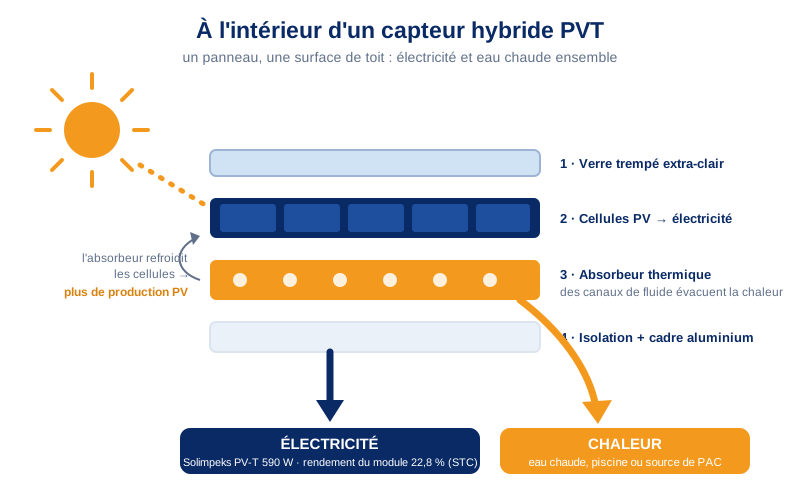
Un capteur hybride PVT (photovoltaïque-thermique) produit de l'électricité et de l'eau chaude sur la même surface de panneau : les cellules photovoltaïques génèrent le courant tandis qu'un échangeur situé derrière elles récupère la chaleur résiduelle. Les cellules étant refroidies activement, un panneau PVT produit jusqu'à 15 % d'électricité de plus qu'un panneau PV comparable et offre un rendement combiné pouvant atteindre 80 %.
Comment fonctionne un panneau PVT ?
Une cellule photovoltaïque standard convertit environ 20 % du rayonnement solaire en électricité — l'essentiel du reste se transforme en chaleur, qui élève la température des cellules et réduit la production d'environ 0,4 % par degré. Dans un capteur PVT, un absorbeur parcouru par un fluide est collé à l'arrière du laminé PV. Le fluide en circulation évacue cette chaleur, refroidit les cellules et transfère l'énergie à un ballon d'eau chaude sanitaire ou au circuit source d'une pompe à chaleur.
Une même surface de toiture remplit ainsi deux fonctions : produire de l'électricité et préchauffer l'eau, chacune améliorant l'autre.
PVT ou panneaux PV et solaires thermiques séparés
| Critère | PVT hybride | PV + solaire thermique séparés |
|---|---|---|
| Surface de toiture pour une production équivalente | Jusqu'à 40 % de moins | Surface plus importante nécessaire |
| Production électrique | +5 à 15 % (refroidissement des cellules) | Production PV standard |
| Rendement combiné | Jusqu'à ~80 % | Dépend de la répartition |
| Complexité du système | Un seul champ de capteurs, un seul système de fixation | Deux technologies, deux fixations |
| Cas d'usage idéal | Surface de toiture limitée, besoins en ECS et en électricité, source pour pompe à chaleur | Grandes toitures, un seul type de besoin |
Quelles températures un panneau PVT fournit-il ?
Les capteurs PVT non vitrés fournissent généralement une eau à 25-45 °C — idéal pour préchauffer l'eau chaude sanitaire, chauffer des piscines ou alimenter le côté source d'une pompe à chaleur eau/eau. Les modèles PVT vitrés atteignent des températures d'eau chaude sanitaire de 60 à 70 °C, au prix de températures de cellules légèrement plus élevées. L'association PVT et pompe à chaleur est la configuration qui progresse le plus vite en Europe ; des dispositifs d'aide tels que le BEG allemand reconnaissent explicitement le PVT comme source éligible pour pompe à chaleur.
Certification : comment les panneaux PVT sont-ils testés ?
Les capteurs PVT sont testés selon la même norme que les capteurs thermiques — ISO 9806 — et peuvent porter le label Solar Keymark, exigé par la plupart des dispositifs d'aide européens. La sécurité électrique et les performances électriques suivent les normes PV habituelles (IEC 61215 / 61730). Les panneaux hybrides PV-T de Solimpeks sont certifiés Solar Keymark (Kiwa Cermet Italia, licence 16918), et Solimpeks fabrique des capteurs PV-T depuis 2008, ce qui en fait l'un des plus anciens producteurs de PVT au monde.
Questions fréquentes
Les panneaux PVT fonctionnent-ils en hiver ?
Oui. La production électrique se poursuit dès qu'il y a de la lumière, et le circuit thermique récupère encore une chaleur basse température utile, notamment comme source pour pompe à chaleur. Les circuits remplis de glycol protègent du gel ; le dimensionnement détermine la production hivernale réaliste.
Les panneaux PVT peuvent-ils remplacer entièrement un chauffe-eau solaire ?
Pour le préchauffage et les besoins à basse température, souvent oui. Lorsque des températures d'eau élevées sont la priorité et que la surface de toiture est généreuse, un capteur thermique dédié fournit toujours plus de chaleur par mètre carré ; de nombreux systèmes combinent les deux.
Quelle est la durée de vie des panneaux PVT ?
La durée de vie de conception est celle de modules PV de qualité : plus de 25 ans, l'absorbeur thermique et les raccords étant réalisés dans les mêmes matériaux que les capteurs plans. Solimpeks fabrique des capteurs PV-T depuis 2008.
Les panneaux PVT sont-ils éligibles aux aides ?
Dans plusieurs pays, oui. Le BEG allemand finance les PVT certifiés Solar Keymark à la fois comme solaire thermique et comme source de pompe à chaleur ; en France, l'aide MaPrimeRénov' autonome pour les capteurs hybrides a pris fin en septembre 2026, mais un PVT utilisé comme source de pompe à chaleur peut relever de la catégorie des pompes à chaleur assistées par le solaire. Les conditions évoluent chaque année — consultez les règles nationales en vigueur.