


A thermosiphon system is a solar water heater that circulates water by natural convection alone: water heated in the collector rises into a tank mounted above it, while cooler tank water sinks back — no pump, no controller, no electricity. It is the simplest and most widespread solar water heating configuration in sunny climates.
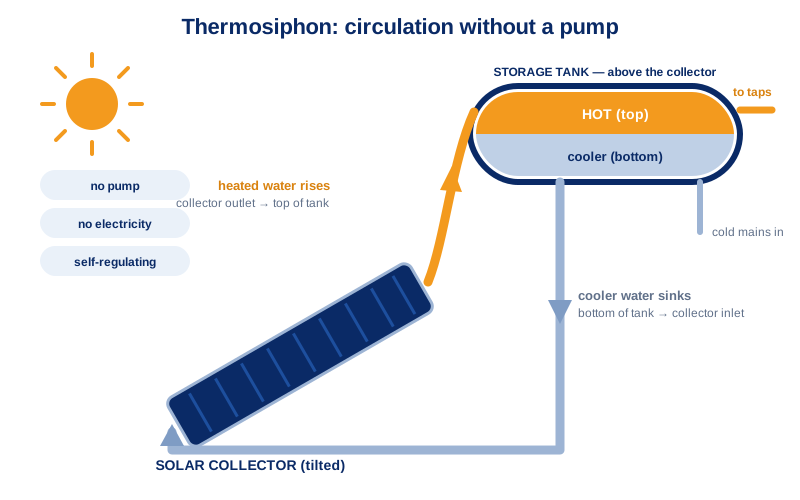
How a thermosiphon works
Water expands as it warms, becoming lighter. In a thermosiphon system the storage tank sits above the collector, so the sun-warmed water in the collector rises naturally through the connecting pipe into the tank while denser cool water from the tank bottom flows down to replace it. Circulation continues exactly as long as the sun delivers heat — a self-regulating loop with no moving parts.
Direct vs indirect thermosiphon systems
- Direct (open-loop): potable water itself circulates through the collector. Maximum efficiency, but only for frost-free regions and good water quality.
- Indirect (closed-loop): an antifreeze mixture circulates through the collector and transfers heat to the tank through a jacket or coil heat exchanger. Standard for regions with freezing nights — including most of Turkey and southern Europe's uplands.
Strengths and limits
| Aspect | Thermosiphon | Forced-circulation system |
|---|---|---|
| Electricity needed | None | Pump + controller |
| Installation | Simple, roof-complete kit | Component system with plant room |
| Cost | Lowest | Higher |
| Tank placement | Must be above collector (roof) | Anywhere (cellar) |
| Architecture | Tank visible on roof | Collectors only |
| Typical use | 1–2 family DHW, sunny climates | Combi heating, large systems |
Factory-made thermosiphon systems are tested as complete units to EN 12976 and can carry Solar Keymark certification as systems. Solimpeks' TSM series (120–350 L) is built on this principle, and the TSM 120–300 systems carry Solar Keymark certification to EN 12976.
Frequently asked questions
Does a thermosiphon work in winter?
Indirect systems with glycol circuits operate year-round; output naturally follows solar radiation. In high latitudes with weak winter sun they are usually paired with an electric backup element or serve as pre-heating.
Why must the tank be above the collector?
The density difference driving circulation is small; the vertical offset between hot collector outlet and cool tank bottom is what creates the driving pressure. Mount the tank below and circulation reverses at night, cooling your stored water.